Donate

Search Website

Khums Calculation

Surplus

Amount you own, in US Dollars ?
Calculated on your khums due date.
Equivalent amount, in US Dollars, of foreign currency you own ?
Calculated on your khums due date.
Debts owed to you that you expect to be repaid ?
Do not include this if it was accounted for in previous financial years.
In-kind possessions not used for sustenance ?
This includes buildings, farms, factories, commodities, work tools, and any household items or possessions not used for sustenance. Calculate these at present value if they were acquired with surplus income on which a year has not elapsed, and at cost price if they were acquired with surplus income on which a year has elapsed. If acquired with a combination of income, then calculate these at present value in relation to what was acquired with surplus income on which a year has not elapsed, and at cost price in relation to what was acquired with surplus income on which a year has elapsed.
Financial dues ?
This includes the due of key premium (surqufliah), the due of utilizing agricultural lands owned by the state, and the due of revival of lands which are fenced and prepared for residency. Calculate these at present value if they were acquired with surplus income on which a year has not elapsed, and at cost price if they were acquired with surplus income on which a year has elapsed. If acquired with a combination of income, then calculate these at present value in relation to what was acquired with surplus income on which a year has not elapsed, and at cost price in relation to what was acquired with surplus income on which a year has elapsed.
Amount you utilized prior to your khums due date ?
This is cash which was subject to khums prior to your khums due date, and which you have already spent (e.g. If this is the first year you pay khums, despite having needed to pay khums in previous years)
Fungible items you utilized prior to your khums due date ?
These are fungible items which were subject to khums prior to your khums due date, and which you have already utilized. Calculate these according to present value. Fungible items are those which are freely exchangeable or replaceable, in whole or in part, for another item of a similar nature, such as machinery or factory-produced fabrics.
Non-fungible items you utilized prior to your khums due date ?
These are non-fungible items which were subject to khums prior to your khums due date, and which you have already utilized. Calculate these according to their value at point of utilization. Non–fungible items are unique items, such as unique paintings, monuments, and unique jewelry.
Amount you already paid with intention of Sahm Al-Imam ?
Amount you paid with the intention of Sahm Al-Imam before your khums due date.
Amount you already paid with intention of Sahm Al-Sada ?
Amount you paid with the intention of Sahm Al-Sada before your khums due date.

Deductions

Commercial debts ?
Include all commercial debts you still owe others.
Remaining sustenance debts taken in the financial year ?
Includes debts borrowed in the financial year for accommodation (mortgage), a car, etc. Please refer to more detailed rulings for accounting for mortgages.
Remaining sustenance debts taken in previous financial years ?
Includes debts borrowed in the previous financial year for accommodation (mortgage), a car, etc. The asset (house, car, etc.) must still be in your possession. Calculate only the amount that you have not deducted from your profits in previous financial years. Please refer to more detailed rulings for accounting for mortgages.
Amount you own which has already been subjected to khums ?
Calculated on your khums due date. Includes the remainder of funds that were subject to khums in previous years and on which you have already paid khums.
Notes
  1. 1) Your khums due date is the first day you started your job or business. If you are retired or not in employment, then you can agree a khums due date with a representative of the marja'a, or calculate separate khums years for each profit that you make, from the date you made that profit.
  2. 2) The khums of commercial commodities and real estate(s) which are intended for trading, should be paid in accordance with their current market value, even if they were bought with profits which a year has elapsed on, unless the price at which they were bought is higher than the current value.
  3. 3) If the calculations show that the amount of khums due is negative as a result of sustenance debts, then the amount of the sustenance debt equivalent to the amount of khums due for the rest of the item is calculated and excluded.
  4. 4) If sustenance debts are fully repaid in the financial year, this amount is excluded from the profits.
  5. 5) Possessions which are not subject to khums are:
    1. a. Possessions owned through inheritance:
    2. i. Cash
    3. ii. Real Estate
    4. iii. Objects that are transferrable and the like
    5. b. Possessions owned by the wife from the dowry (mahr):
    6. i. Cash
    7. ii. Gold Jewellery
    8. iii. Home furniture and the like
    9. c. Possessions used for personal or family provisions from the profits of that financial year:
    10. i. Home residence
    11. ii. Home furniture and other household items
    12. iii. Gardens used for leisure and to personally benefit from their fruit
    13. iv. Personal or family cars
    14. v. Animals that are benefited from by the household such as a cow for milk or a chicken for eggs
    15. d. Debts owed by others that you do not expect to be repaid.
    16. e. Items purchased through debt that has not yet been repaid.

Total amount subject to Khums $0

Khums Due $0

Sahm al Imam to be paid $0

Sahm al Sada to be paid $0

Email me Khums report

Join us for Al-Ayn’s Parenting Seminar, The Amanah of Parenthood, in a city near you!  Register Now

Our Special Consultative Status

Al-Ayn Social Care Foundation International is an umbrella organization with 15 global members, representing fundraising and field offices. In 2016, Al-Ayn Iraq was granted special consultative status with the UN Economic and Social Council (ECOSOC), recognizing our expertise in sustainable development, including economic, social, and environmental aspects.

This status highlights our contributions and allows active participation in UN conferences and events.

Our Goals 

Through written statements, oral interventions, and side events, Al-Ayn has highlighted the struggles of two often-neglected groups, orphaned children and widowed mothers. Our special consultative status provides a platform to raise awareness of these challenges and the support we provide.

We aim to achieve the following through our participation:

1

Present to the international community Al-Ayn’s extensive work to support orphaned children in Iraq, Afghanistan, and Ghana. 

2

Showcase initiatives such as our Luminous Stars centers and the Hikayati center. 

3

Raise awareness of the period of violence in Iraq that still affects communities to this day and advocate for the victims of that period.

4

Build key relationships within the international community to exchange experiences and best practices.

Our Participations 

Since receiving special consultative status in 2016, Al-Ayn has participated in 26 UN sessions, including the Human Rights Council in Geneva and key forums in New York, such as the High-Level Segment of the High-Level Political Forum on Sustainable Development, the Commission on Social Development, and the Commission on the Status of Women. These engagements raise awareness of the challenges faced by orphaned children and their families and showcase our work supporting them.

In November 2025, we attended the Second World Summit for Social Development in Doha, participating in sessions on global social issues, poverty alleviation, reducing inequality, and promoting social inclusion.

Our participation reflects our commitment to the UN Convention on the Rights of the Child and the Sustainable Development Goals (SDGs).
Our Side Event 

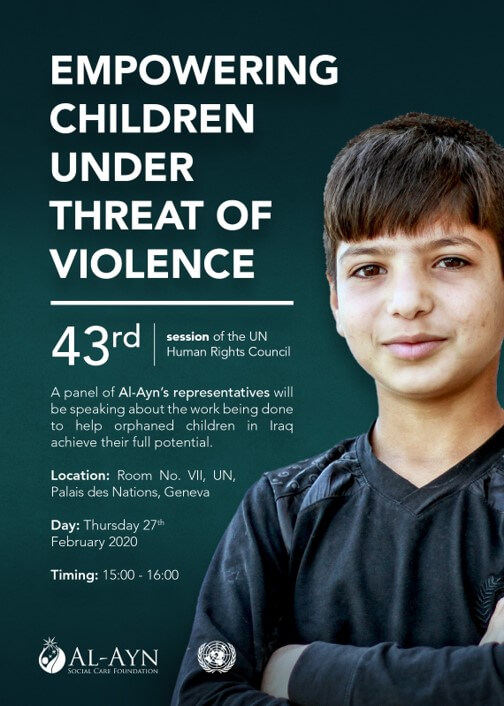
On 27th February 2020, Al-Ayn hosted a side event titled Empowering Children Under the Threat of Violence at the United Nations Palais des Nations in Geneva.

The event introduced the origins of Al-Ayn Social Care Foundation – founded to document the lives lost due to terrorism and human rights violations following the 2003 Iraq conflict, and to care for the families left behind.

We provided an overview of our services, shared impactful case studies of orphaned youth supported by the foundation, and presented the vision behind Hikayati, our purpose-built, child-centered facility in Najaf, Iraq.

Sustainable Development Goals

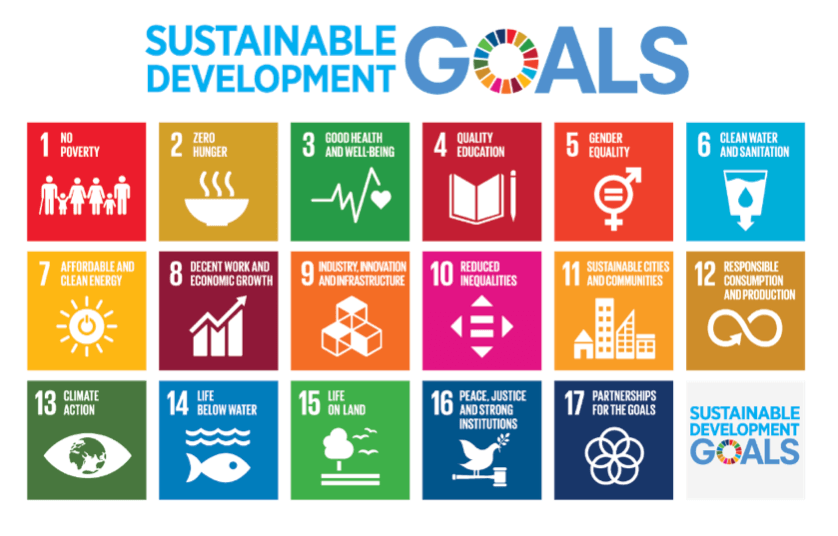
In 2015, the United Nations adopted the 2030 Agenda for Sustainable Development, which includes 17 Sustainable Development Goals (SDGs) calling for urgent action worldwide. The SDGs recognize that ending poverty also requires addressing health, education, economic growth, climate change, and environmental challenges.

At Al-Ayn, our work focuses on breaking the cycle of poverty for vulnerable groups, particularly orphaned children and widowed mothers, aligning our initiatives with multiple SDGs.

SDG 1 – No Poverty

Al-Ayn was founded to support orphaned youth and widowed mothers living in poverty. Our efforts are aimed at lifting these groups out of poverty and enabling them to become independent contributors to their societies in the long run.

SDG 2 – Zero Hunger

Al-Ayn runs food distribution programs in Iraq, Ghana, and Afghanistan, including emergency aid during crises like COVID-19.

SDG 3 – Good Health & Well-being

Al-Ayn’s ‘Luminous Stars’ centers provide medical care, while our ‘Hikayati’ program offers art-based therapy as part of a holistic approach to health and well-being. We are building a medical complex for orphaned children and their families, as well as impoverished people.

SDG 4 – Quality Education

Al-Ayn provides financial aid for school and university fees, vocational training, and personalized educational support. We also facilitate sponsorship of university fees and contributions to university tuition. Currently, 815 orphaned youth in universities are being supported by Al-Ayn.

SDG 5 – Gender Equality

Al-Ayn offers equal support to orphaned boys and girls, with special programs to empower widowed mothers through vocational training and microfinance.

SDG 6 – Clean Water & Sanitation

In July 2024, we initiated our first ‘WASH’ project, which involved successfully pumping clean, safe water to a small village on the outskirts of Accra in Ghana. 

SDG 8 – Decent Work & Economic Growth

Al-Ayn’s vocational training programs provide youth with practical, contemporary skills – such as mobile phone repair, so they are better equipped to join the labor market and become active members of society.

We also offer microfinance options to orphaned youth and widowed mothers to help them start their own businesses, encouraging independence and entrepreneurship.

SDG 10 – Reduced Inequalities

All Al-Ayn’s work is aimed at reducing poverty and therefore bridging inequality gaps in society, whether it’s our vocational training centers, Luminous Stars, designed to equip orphaned youth with key skills for employment, or our sponsorship programs. We also recognize different types of inequalities in society and have tailored our support accordingly. For example, we have a special type of sponsorship with a higher rate for children and youth with medical needs that require additional support.

SDG 16 – Peace, Justice & Strong Institutions

Al-Ayn has detailed processes and procedures in place, with thorough checks and controls at different levels to ensure that there is no corruption, there is proper means assessment, and only eligible beneficiaries receive support.